

Gazebo Weights: Which Ones Do You Actually Need?
Anyone who’s watched a gazebo, beach umbrella cartwheel across a beach knows why securing your gazebo matters.
A 3 m × 3 m gazebo canopy is nine square metres of sail on four legs, and a gust that barely moves your hat can lift it onto a car, a stall or a kid. They weigh upwards of 20kgs, and can really do some damage.
On grass you can peg it down. On rock, concrete, pavers or a bitumen, weights are the only thing holding it in place and when public liability is of concern (as it always should be) - ensuring you've got your gazebos secure is critical.
Caption: Crowds narrowly avoid major injury to people or property from flying gazebo.
Weights are cheap insurance. The three main types – sandbags, fillable plastic pods, and cast iron or steel plates – all do the job, but they differ in price, hassle, durability and whether a market organiser will accept them. Here’s how to choose, and you can shop the whole range on our gazebo weights page.
How much weight does a gazebo need?
More than most people use.
Australian market organisers have settled on 15–20 kg per leg without walls and 40 kg per leg with them.
In Brisbane, the Brisbane City Markets (Reddacliff Place, Cathedral Square, St Stephens) require 15 kg on every leg as a condition of trade, and spot-check it. Most councils further south set 20 kg – Bathurst Regional Council, Central Coast Council’s Make it Big Market, Akoonah Park Market in Berwick and Whitehorse council in Melbourne’s east – and Whitehorse and Akoonah Park double it to 40 kg for walled gazebos, because walls roughly double the wind load.
| Setup | Minimum per leg | Who specifies it |
| Canopy only (Brisbane) | 15 kg | Brisbane City Markets – condition of trade, spot-checked |
| Canopy only | 20 kg | Bathurst Regional Council, Central Coast Council – Make it Big Market, Akoonah Park Market, Whitehorse council (Melbourne) |
| With sidewalls | 40 kg | Whitehorse council (Melbourne), Akoonah Park Market |
| Market umbrella | 40 kg | Whitehorse council (Melbourne) |
Treat those as a floor. Add more on exposed sites – beachfront, open paddocks, showgrounds – and read your own market's terms, because the organiser's number is the one that sends you home.
Not every market publishes a figure, but they all check: Burleigh Market on the Gold Coast makes weights on every leg mandatory in any weather, Cotters Market in Townsville requires every tent weighted or anchored in all conditions and cancels on a cyclone warning, and Cairns Regional Council bans pegging into its parklands.
Two rules turn up almost everywhere: purpose-made gazebo weights only (Bathurst bans improvised weights, Whitehorse bans plastic bags and buckets), and no pegging.
Weight is only half of it. Weights must be attached to the leg or frame; a 15 kg bag sitting beside a leg does nothing once the gazebo lifts.
Matching weight to the forecast
Some organisers tie their rules to the wind forecast. Organic Food Markets in Sydney treats a commercial-grade gazebo with 20 kg per leg as safe to 40 km/h average wind (about Beaufort 5); above that, canopies come off, and above 61 km/h the market is abandoned. Between those two thresholds, stacking a second weight per leg is the usual answer. A sensible plan:
| Forecast wind | Weight per leg | What else |
| Up to 40 km/h | 20 kg (40 kg with walls) | The standard market minimum |
| 40–60 km/h | 30 kg or more – stack a second weight | Walls off; expect to be told to drop the canopy |
| Over 60 km/h | - | Markets close; take the canopy down |
Check both the average and gust figures on the BOM forecast, and check again on the morning. Market managers with an anemometer go by what they measure on the day.
Bigger gazebos: double up on the corners. On a 6 × 3 m gazebo, the four corner legs take far more lift than the two in the middle, so organisers usually ask for double weight on the corners – two stacked plates or bags each – and a single on the centre legs. Under a moderate-wind rule that's ten weights, not six, which is why stackable weights pay off.
Sandbag weights
The cheapest option and where most campers start: polyester bags with Velcro or webbing straps that wrap the leg. You buy them empty and fill them with sand.
What’s good: price. A four-pack of gazebo sandbags costs less than one cast iron plate, and sand is free. Empty, the set weighs a few hundred grams and folds into the gazebo bag. Heavier-duty versions like the OZtrail Commercial Sand Bag hold up to 20 kg and pin directly to the frame.
What’s not: fabric. Bags get cut, dragged and punctured, leak through seams and zips, and go brittle under Australian UV after a couple of seasons. And a bag sold as “15 kg” is only 15 kg if you got 15 kg in it.
Before you rely on them: weigh each filled bag on the bathroom scales and write the figure on it.
Fillable plastic weights
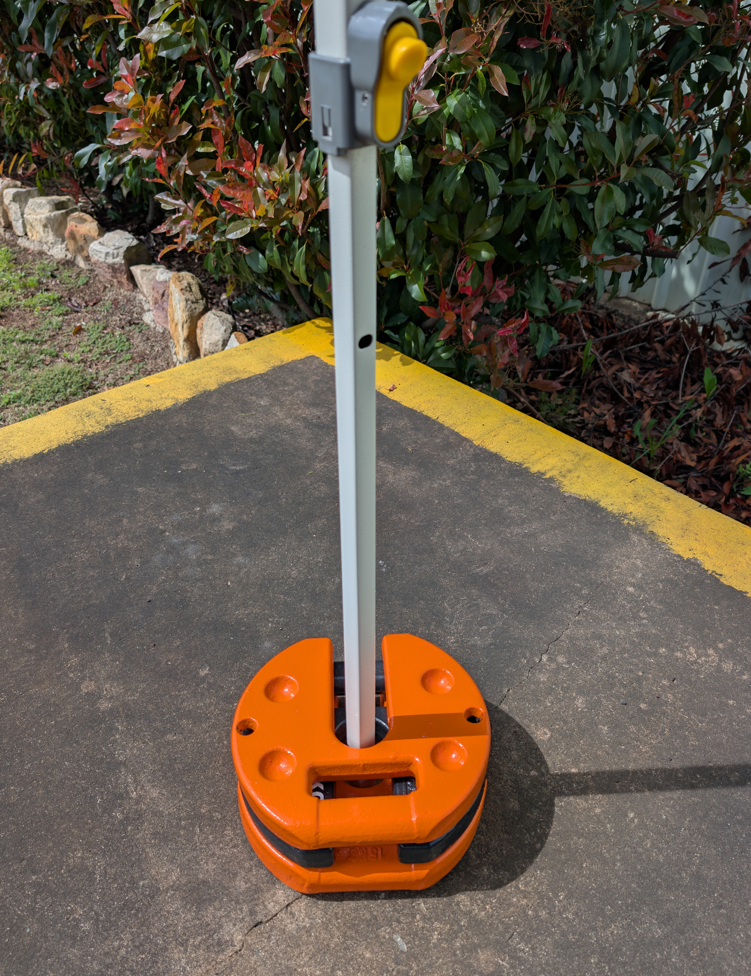
Moulded plastic shells – pods, discs or cylinders – that clamp around the base of each leg and fill with water, sand or both. The OZtrail Base Pod Kit is the typical example.
What’s good: they travel light and set up fast. Empty they weigh nothing; fill from a tap on site and tip out at pack-down. Tougher than fabric, and most stack for windy days. The sweet spot for regular users who don’t want to lug iron.
Water or sand? Water is about 1 kg a litre; dry sand about 1.5 kg. The same pod is half again as heavy with sand, and makers usually quote the sand figure – a “12 kg” pod may give you 8 kg with water. Fill with sand for the full rating, or use two per leg with water.
What’s not: still plastic. Years of sun make shells brittle, caps crack and weep, and a hard drop can split one. Store them out of the sun, and weigh them once after filling.
Cast iron and steel weights
The serious option: solid plates of 10–15 kg with a slot for the leg and usually a handle, most of them stackable. Tentworld’s own come in 10 kg and 15 kg. They cost the most, and they’re what stallholders, caterers and sporting clubs end up with - anyone with public liability concerns.
What’s good: nothing to fill, weigh or empty. Lift them out of the ute, drop them on the legs, trade. The rating is cast into the plate, so the market manager can read “15 kg” off the top without debating how full your sandbag is. And they last: iron doesn’t tear, leak or go brittle. The paint scratches, but a spray can every season or two keeps rust off.
What’s not: they're always heavy, even in storage. They’re the easiest to steal at a busy event. Mark them, or cable tie them to the frame.
Don’t drop them. Cast iron is brittle. A plate landing on an edge or corner on concrete can crack or chip; a chipped corner is cosmetic, but a crack through the leg slot means the plate can split under load and needs replacing. Lower them onto the legs.
Side by side - how they compare
| Sandbags | Fillable plastic | Cast iron / steel | |
| Price | $ | $$ | $$$ |
| Ready to use | No – fill with sand | No – fill with water or sand | Yes |
| Weight marked on it | No | Rated, but depends on filling | Yes |
| Weigh after filling? | Yes | Yes | No |
| Durability | Low – tears, leaks, UV | Medium – UV, cracks | High – decades |
| Transport | Light when empty | Light when empty | Heavy, always |
| Stackable | Rarely | Usually | Usually |
| Accepted at markets | Sometimes | Sometimes | Usually preferred or required |
| Can be dropped | Usually fine | No – likely to crack and then leak | No – brittle |
Which should you buy?
Camping, picnics, the odd backyard party: sandbags. A handful of uses a year, next to no cost, packs flat. Fill, weigh, label.
Occasional stalls, or short on car space: fillable pods. Carry them empty, fill on site, stack a second set when it's windy. Sand for the full rating.
When public liability is of concern. Sports clubs, weekly markets, caterers, anyone who uses weights regularly: cast iron or steel. The outlay stings once, but it buys reliability. A split sandbag or a cracked pod cap at 6 am on game day means a dash to the shops or a gazebo that doesn't go up. Iron doesn't fail, the printed rating keeps organisers happy, and the saved setup time pays it back every weekend. Buy stackable.
If in doubt, go heavier. Nobody has ever regretted too much weight on a gazebo.
See the full range of gazebo weights at Tentworld, from sandbag four-packs to cast iron. Still choosing a frame? Our gazebos and shelters range runs from compact camping pop-ups to 3 × 3 and 6 × 3 commercial frames, with side walls and anchors to match. Always try to use appropriate pegs too, whenever you can.
Using your weights properly
Using your weights properly
Whichever you choose, a few habits keep the gazebo where you put it.
- Weights on first, off last. Fit them as soon as the frame is up; remove them only when you're ready to collapse it.
- Every leg, every time. Two weighted legs make a hinge.
- Attach, don't rest. A weight on the ground beside the leg is decoration.
- Peg as well on grass. Pegs, guy ropes and anchors plus weights beat either alone. (if event organiser permits it!)
- Add weight for walls. Side walls multiply wind load; most markets want 40 kg a leg once they go on.
- Watch the forecast. Above 40 km/h, stack a second weight or drop the canopy; above 60 km/h, markets close.
- Don't leave it unattended in wind. Drop the canopy first.
Shop: gazebo weights · sand bags · side walls · gazebos and shelters.